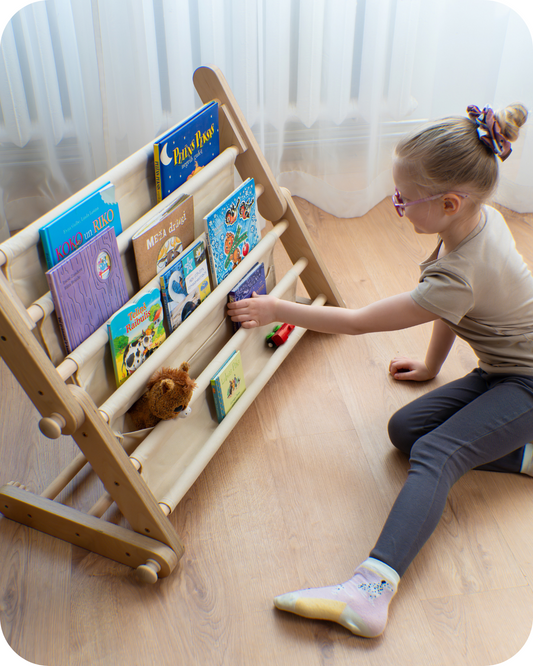
We build learning towers. Step stools. Furniture that lets small children reach adult-height kitchen counters, stand next to a parent while dinner is made, and wash their hands without asking for help.
For years, we talked about independence. About the Montessori idea that children learn by doing — and that the right-sized environment lets them do more of it.
But lately, something else has been on our minds. And we think it’s worth saying out loud, even if it’s not what you’d expect from a furniture brand.
Ette Tete started with our own children. When we became parents, we dove deep into children’s furniture—designing products that fit the reality of everyday family life: furniture that grows with the child, activity toys that encourage freedom of movement, and step stools that let small hands actually reach the kitchen counter. Things that make daily life easier for both children and parents.
But children grow, and so did what we were paying attention to.
We started noticing what was happening around us — in supermarket aisles, in childhood obesity statistics across Europe, in the gap between what gets marketed as healthy and what actually is. The more we looked, the more we kept running into the same question: how much of what we believe about nutrition is real, and how much of it is something the food industry convinced us of?
That’s what prompted us to start talking about it. Beginning with what we’ve learned ourselves — often the hard way.
What we didn’t know — and should have. Flour is processed like sugar
For years we treated white bread, pasta, and crackers as neutral. Not “sugar foods.” Just everyday staples.
We were wrong.
When flour is refined, the bran and germ are removed, leaving almost pure starch. The body breaks this down into glucose rapidly — often faster than table sugar. White bread has a glycemic index of approximately 75. Table sugar — sucrose — sits at around 65. [Atkinson et al., International Tables of Glycemic Index and Glycemic Load Values, American Journal of Clinical Nutrition, 2008.]
White bread raises blood sugar faster than a chocolate bar. The rice cake marketed to toddlers as a light snack sits in the same category. Our bodies — and our children’s bodies — don’t read the packaging. The liver sees glucose.
Orange juice vs cola
Here’s a comparison we wish someone had shown us earlier.
A medium orange contains roughly 9 grams of sugar and 2.4 grams of fibre [USDA FoodData Central]. To make one glass of juice (around 250 ml), you need three to four oranges. That’s 27–36 grams of sugar in the glass. A 250 ml serving of cola contains approximately 26 grams of sugar.
The numbers are nearly identical.
The difference is what happens in the juicer: the fibre—the part that slows sugar absorption and buffers how quickly it enters the bloodstream—ends up in the pulp we throw away. What’s left is liquid fructose and glucose, absorbed quickly, without the nutritional buffer the whole fruit provides.
Research published in the BMJ found that while whole fruit consumption was associated with a reduced risk of type 2 diabetes, fruit juice was associated with an increased risk. [Muraki et al., BMJ, 2013.] The fibre matters that much.
This doesn’t make orange juice the enemy. It means “natural” and “healthy” aren’t the same thing —and the way food is marketed to parents doesn’t always make that distinction.
The marketing problem
Walk through the children’s snack aisle of any supermarket. Corn puffs with added vitamins. Cereals labelled “no added sugar” that contain 20+ grams of refined carbohydrates per serving. Fruit pouches with no fibre.
These products aren’t formulated for children’s health. They’re designed for convenience, to appeal to children visually, and to reassure parents with strategically placed claims. The food industry won’t change this — the confusion is profitable.
Why this connects to what we make
Our products bring children into the kitchen. That’s their purpose — a learning tower at counter height means a two-year-old can stand next to you while you cook, can reach the sink, can be present with food before it reaches the table.
But physical access is only part of it.
When a child can reach the fruit bowl, they can start to learn what’s in it. When they help wash vegetables, they develop a different relationship with them. The independence our products create—the ability to get their own glass of water, to participate in food preparation as part of a daily routine—is a window into the kind of education the snack aisle won’t provide.
We can design the environment. We can make real food accessible. The food industry is very good at reaching children — but so is a well-designed kitchen.
We’re parents first. Not experts.
We’ve been parents for twelve years. We’ve made mistakes — reached for the convenient option, trusted the packaging, bought the cartoon cereal. We’re still learning.
We’re not a nutrition authority, and we won’t pretend otherwise. But we think these conversations are worth having — and we’d rather have them with people who actually know what they’re talking about than say nothing and stay in our lane.
The people who do know
That’s why we’ve started working with nutritionists and feeding specialists who can help us go deeper on these questions.
Our first collaboration is with Emelie Vessey, a Registered Nutritionist specialising in feeding psychology and helping families raise children with healthy relationships with food. She holds an MSc in Nutrition & Behaviour and a BSc in Psychology, and has worked in the field for over ten years — including years focused on disordered eating and eating disorder prevention. She’s also a mother of two young children, so her work combines evidence-based nutrition with the daily reality of feeding a family.
We worked with Emelie on a reel about involving children in the kitchen—not as a performance, but as a habit that builds skills and food awareness from an early age.

You can follow her here:
• Instagram: @emelie.vessey
• TikTok: @emelie.vessey
This is the beginning of something we plan to develop further — more conversations, more experts, more honest content about raising children with a healthy relationship with food. Not because we have the answers. Because we think the questions are worth asking.
References
- Atkinson FS, Foster-Powell K, Brand-Miller JC. International tables of glycemic index and glycemic load values: 2008. Diabetes Care, 31(12), 2281–2283. https://diabetesjournals.org/care/article/31/12/2281/28367
- U.S. Department of Agriculture. FoodData Central — Orange, raw. https://fdc.nal.usda.gov/food-details/169097/nutrients
- Muraki I et al. Fruit consumption and risk of type 2 diabetes: results from three prospective longitudinal cohort studies. BMJ, 347, f5001 (2013). https://www.bmj.com/content/347/bmj.f5001