Quick answer: A child's feet should rest flat on the floor, knees at roughly 90°, and the tabletop should sit at elbow height when seated. Deviating from this — even by a few centimetres — increases spinal load, tyres muscles faster, and reduces sustained concentration. The right furniture grows with your child or is sized to their current phase.
Why seat and table height matter more than parents realise
Adults instinctively know when a chair is wrong for them — their back aches, they fidget, they get up frequently. Children do all of those things too, but adults tend to attribute it to restlessness rather than discomfort.
The truth is that children spend a significant portion of their waking hours seated. By age three, structured play, eating, and creative activities already add up to three or more hours of seated time per day. By school age, that number rises sharply. Every hour spent on furniture that is the wrong height is an hour of unnecessary postural strain.
The chair and table are not passive objects. They are an active part of the environment in which your child learns, eats, draws, and develops habits of body and mind. Getting the dimensions right is a practical investment, not a luxury.

How wrong dimensions affect posture and the developing spine
A child's spine is not a miniature adult spine. The lumbar curve — the gentle inward curve at the lower back — is still developing through early childhood and is particularly vulnerable to sustained poor positioning. Unlike adults, who have decades of established muscle memory and bone density working in their favour, children are actively building the muscular and skeletal frameworks they will carry for the rest of their lives.
When the seat is too high
When a child cannot touch the floor with their feet, they are forced to either perch on the front edge of the seat (losing back support entirely) or dangle their legs, which rotates the pelvis backward and flattens the lumbar curve. Both positions increase compressive load on the lower vertebrae and quickly tire the core muscles. A tired core means a slouch — and a habitual slouch reshapes the soft tissues around the spine over months and years.
When the seat is too low
A seat that is too low causes the knees to rise above the hips. This tilts the pelvis forward and exaggerates the lumbar curve in an uncontrolled way. Children compensate by leaning forward at the hips or rounding the upper back, both of which shift the head forward relative to the shoulders and increase the load on cervical vertebrae. The longer this position is held, the more tension accumulates in the neck and upper back.
When the table is the wrong height
A table that is too high causes the child to elevate their shoulders and reach upward — a position that strains the trapezius and shoulder muscles continuously. A table that is too low causes the child to round forward, bringing the chin toward the chest and loading the cervical spine. Neither position is compatible with sustained, comfortable activity.
The compounding effect: Poor seated posture does not just cause physical discomfort. When muscles are working overtime to maintain balance, they consume energy and attention that would otherwise be available for cognitive tasks. A child who is physically uncomfortable cannot focus.
The link between ergonomics and focus in children
Ergonomics research in school settings has consistently shown a correlation between appropriate furniture sizing and children's ability to sustain attention. When children are comfortably seated with both feet on the floor and the work surface at the right height, they move less, maintain gaze on the task more consistently, and report less discomfort.
This makes intuitive sense. Proprioception — the body's sense of its own position in space — is highly active in young children. When posture is unstable, the nervous system allocates resources to balance and correction that might otherwise support learning and play. The well-positioned child is, quite literally, freed up to concentrate.
Independent play at a well-fitted table also encourages the kind of sustained, absorbed engagement that child development specialists associate with deep learning. It is not coincidental that many educational philosophies that emphasise child-led discovery also emphasise child-appropriate furniture: the physical environment directly enables or constrains the quality of engagement.
How to find the right seat height and table height for your child
The measurements below assume your child is sitting upright with shoulders relaxed — not slumped, not rigidly straight. This is the neutral position you are designing for.
Correct seat height
Measure from the floor to the back of your child's knee (the popliteal fold) while your child is standing. That measurement is your target seat height. When seated, both feet should rest flat on the floor with the knee at approximately 90°. A small variation of 1–2 cm is acceptable; more than that, and the benefits begin to erode.
Correct table height
With your child seated correctly (feet flat, knees at 90°), measure from the floor to the bottom of their elbow when the arm hangs naturally. The tabletop should sit at or just slightly below that height — approximately 1–2 cm lower. This allows forearms to rest comfortably on the table without lifting the shoulders or dropping the elbows.
The table below shows standard reference dimensions by age and stage:
| Age stage | Approx. age | Table height (cm) | Seat height (cm) |
|---|---|---|---|
| Infant | 6–12 months | 30–33 | 13–15 |
| Toddler | 1–2 years | 33–36 | 15–18 |
| Toddler | ~2 years | 35 | 18 |
| Toddler / Preschool | 2–3 years | 40 | 20 |
| Toddler / Preschool | 2–4 years | 43 | 23 |
| Preschool | 3–5 years | 46 | 25 |
| Preschool / Kindergarten | 4–6 years | 48 | 28 |
Always measure your child rather than relying solely on age — children of the same age vary considerably in height.
Practical tip: After adjusting or choosing furniture, have your child sit naturally for a few minutes before you check the position. Children automatically compensate when they know they are being observed. A natural seated posture tells you far more than one that's been asked for.

Signs that the furniture is the wrong size
You do not need to measure every time. Children communicate through behaviour when furniture does not fit:
- Feet dangling or tucked under the chair rather than resting on the floor
- Perching on the edge of the seat rather than sitting back in it
- Slumping sideways or forward within minutes of sitting down
- Raising shoulders toward ears while drawing or eating
- Leaning over the table rather than sitting close and upright
- Leaving activities much sooner than interest would suggest
- Complaining of a sore back, neck, or feeling tired during or after activities
If you regularly observe several of these, a furniture review is worth doing before assuming the issue is motivational or behavioural.
What to do as your child grows
Children grow an average of 5–7 cm per year between the ages of two and eight, the phase when seated activities are becoming an increasingly significant part of daily life. A chair that fits well at age three is likely to be borderline by age four and genuinely wrong by age five.
There are two practical approaches:
Adjustable furniture — chairs and tables with height-adjustable seats or legs allow you to grow the furniture incrementally alongside your child. The adjustment mechanism needs to be secure and simple enough to be actually used.
Staged replacement — some families prefer a fixed-height chair that fits precisely at a given stage, accepting that it will need to be replaced in two to three years. This works well if the initial fit is exact and the subsequent replacement is planned.
Whichever approach you choose, set a reminder to recheck the fit at least once a year or whenever a growth spurt becomes noticeable.
How the Tulla table and chair set addresses these challenges
Most children's furniture forces a choice: buy something that fits now, or buy something you hope will fit later. The Tulla table and chair set resolves this differently — through a genuinely adjustable system that covers a wide age range without compromising on the precision of fit at any stage.
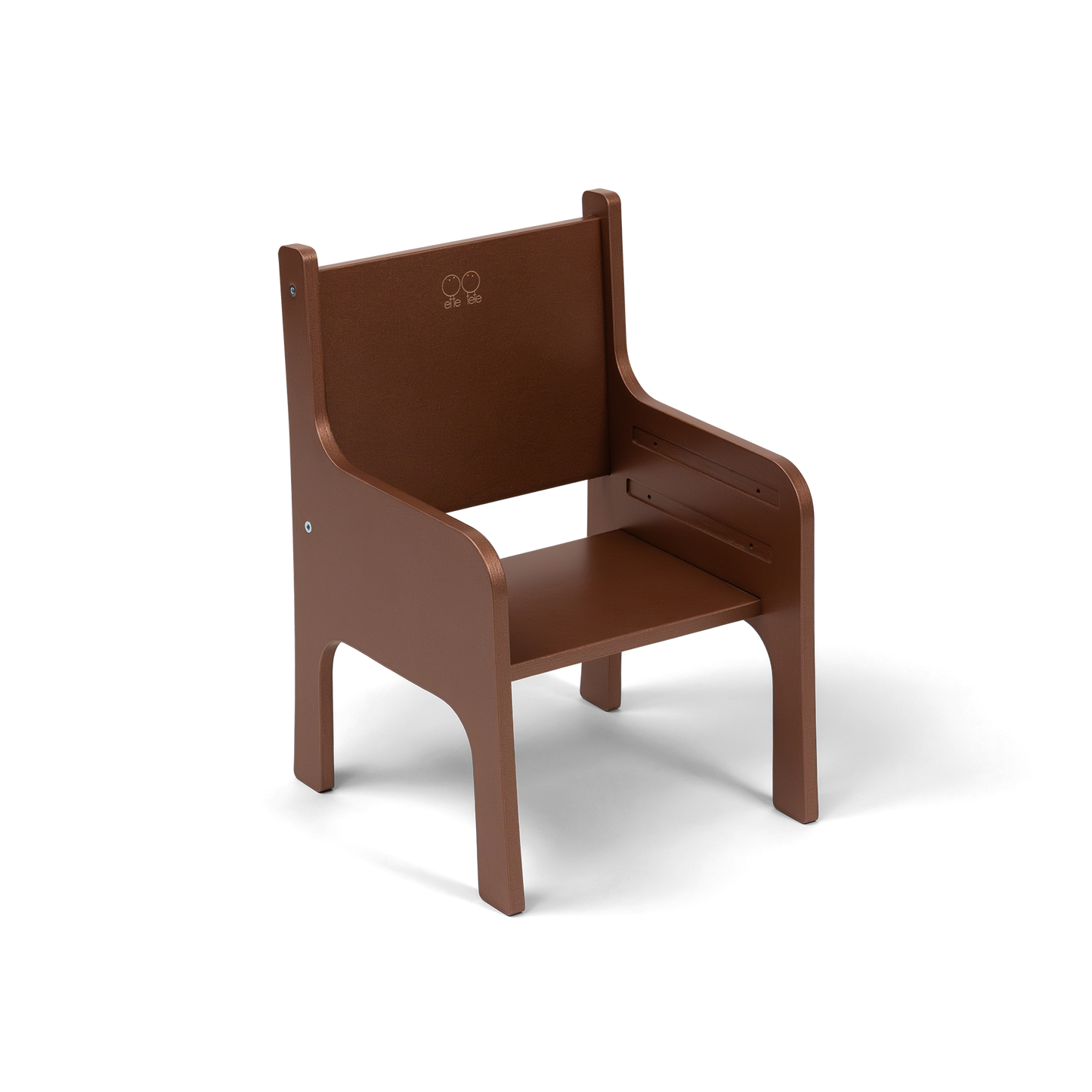
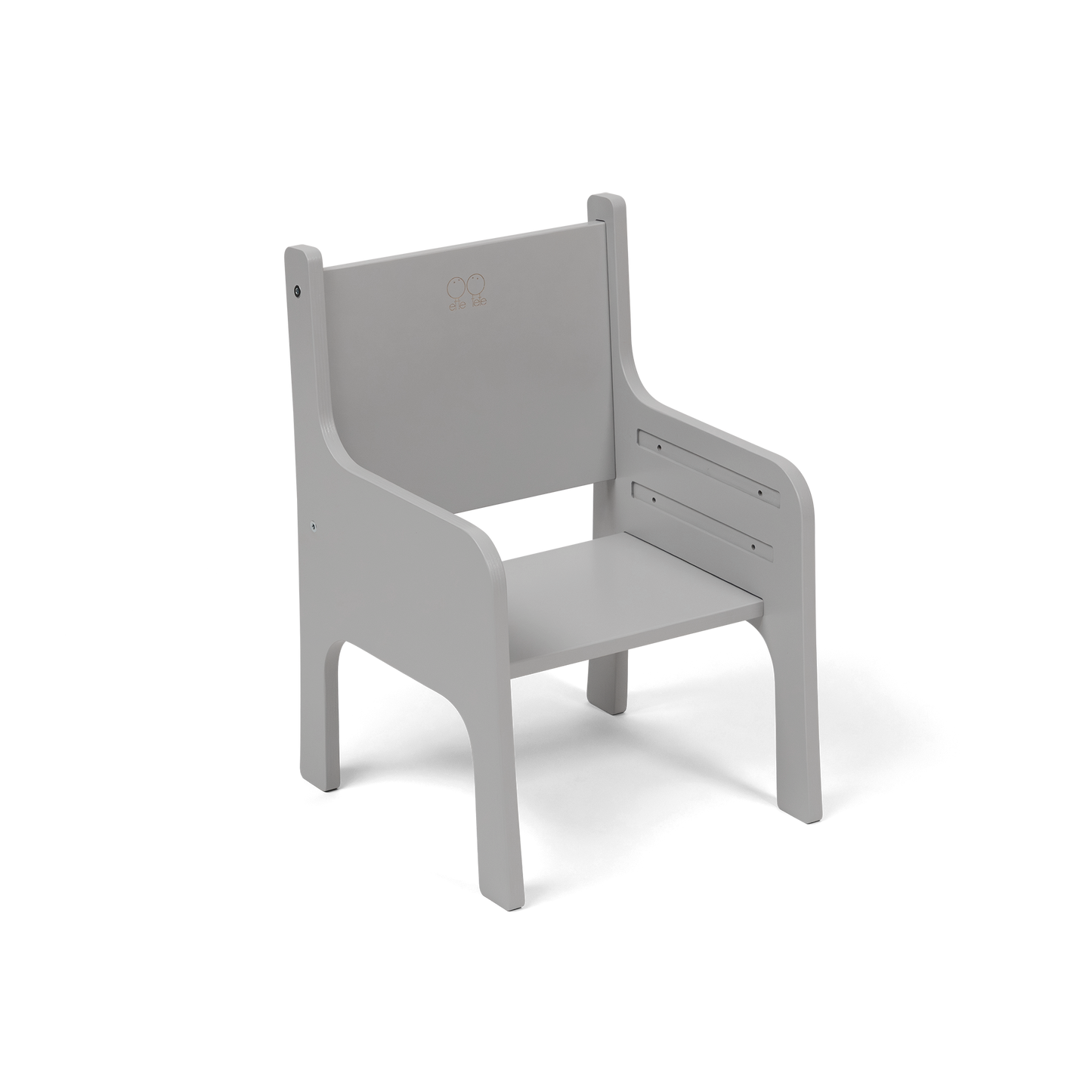
Designed for children aged approximately 1.5–6 years, the Tulla is built around the idea that ergonomic fit should not require a furniture replacement every time your child grows. The chair seat adjusts across three heights using a screwless system — no visible fixings on the sides, just lift or lower the seat panel to the next position with a hex screwdriver. The table switches between two heights with equal simplicity.

- Three chair seat heights (18cm / 23cm / 28cm) — covers the full toddler-to-kindergarten range with correct foot-flat, knee-at-90° positioning at each stage
- Two table heights (36.5 cm / 49.5 cm) — each pair with the corresponding chair position to maintain the correct elbow-to-surface relationship
- Easy seat adjustment — no visible fixings on the sides; seat panel fixed in the position with smart Lamello connectors
- Solid wood construction — birch plywood, manufactured in Latvia; stable, non-tipping, built to last well beyond a single growth stage
- Rounded edges and smooth surfaces — finished to a standard safe for everyday independent use by young children
- Compact proportions — sized so a child can reach the far edge of the table without leaning forward, keeping the upper body upright
- EN certified — meets European safety standards for children's furniture
The Tulla does not ask you to anticipate how big your child will be, or to compromise between fit-now and fit-later. You adjust it when the fit changes — quickly, without disrupting the room or reaching for a screwdriver — and the correct ergonomic relationship between your child's body and the furniture is restored.
That is the practical advantage of furniture designed around how children actually grow: not in one leap, but incrementally, in the same room, at the same table, in the same chair — just set a little higher each time.

Frequently asked questions
What is the correct seat height for a child's chair?
The correct seat height places the child's feet flat on the floor with the knee bent at approximately 90°. To find the right number, measure from the floor to the back of your child's knee while your child is standing. Reference ranges run from approximately 18 cm at age 2 to 28 cm at ages 4–6.
What height should a children's table be?
A children's table should sit at or just slightly below elbow height when the child is seated correctly. Standard ergonomic references suggest 35 cm at around age 2, rising to 40 cm at ages 2–3, 43 cm at ages 2–4, 46 cm at ages 3–5, and 48 cm at ages 4–6.
Does the wrong chair height really affect posture in the long term?
Yes. A child's spine and supporting muscles are still developing, and sustained poor positioning — particularly in the early years — can contribute to muscle imbalances and habitual posture patterns that persist into adolescence and adulthood. The risk is not dramatic or immediate, but it is real and cumulative.
How often should I check whether my child's furniture still fits?
At a minimum, once a year. Children grow 5–7 cm per year on average between ages two and eight, which means a well-fitting chair can become too small within 18–24 months. A practical trigger is any noticeable growth spurt, or the signs listed above — feet dangling, perching on the edge, or slumping quickly.
Is adjustable children's furniture better than a fixed-size set?
For most families, yes — adjustable furniture ensures the correct ergonomic fit is maintained as the child grows, without needing to replace the piece every two to three years. The key is how easy the adjustment is: a tool-requiring mechanism tends not to be used. The Tulla chair uses a screwless system in which the seat panel lifts and repositions with just a hex tool across three heights, and the table switches between 36.5 cm and 49.5 cm simply by switching the legs, making it easy to keep the fit current.
At what age does a child need their own table and chair?
Many families introduce a child-sized table and chair between 18 months and 3 years, as sustained, independent seated play becomes part of the daily rhythm. A dedicated children's table and chair becomes most valuable once the child is regularly engaged in independent activities — drawing, play-dough, puzzles, or books — that benefit from a stable, correctly sized work surface.